
If you’ve ever Googled affordable therapy in Philadelphia and felt your stomach drop at the prices, you’re not alone. The hard part isn’t “realizing therapy could help.” The hard part is figuring out how to actually get care, without draining your savings, without having to explain your identity 12 times, and without feeling like you’re asking for “too much” by wanting a therapist who gets it.
At the Therapy Center of Philadelphia (TCP), we work with Women, Transgender, and Gender expansive people across Pennsylvania, and we hear the same questions all the time:
- “Is sliding scale therapy real, or is it a myth?”
- “Can I use Medicaid for therapy in Philly?”
- “How do I find LGBTQ friendly therapy that’s actually Trans-affirming?”
- “What should I look for so I don’t waste months with the wrong provider?”
This guide is here to make the process clearer, especially if you’re looking for low-cost mental health services, accessible mental health care, and identity-affirming therapy in areas like Center City, West Philadelphia, and South Philadelphia.
What “Sliding Scale Therapy” Means
Sliding-scale therapy is a reduced-fee model based on your ability to pay. Instead of a fixed rate (like $150/session), a clinician or practice offers a range by considering:
- Your income and household size
- Your insurance status (uninsured, underinsured, out-of-network, etc.)
- Financial stressors (student loans, caregiving costs, housing instability, etc.)
A key point people don’t always tell you up front: sliding-scale availability can change from week to week. Some providers have open spots; others have waitlists. That’s why having a clear search plan matters.
Why Affordability And “Fit” Both Matter (Especially For Identity-Centered Care)
When you’re looking for gender-affirming counseling like Trans-affirming therapy, LGBTQ friendly therapy, Queer-friendly therapy, or support from a Nonbinary therapist, it’s not “extra” to want a provider who understands your lived experience.
Feeling respected and understood in therapy isn’t just nice; it’s part of what makes therapy work. There’s strong evidence that psychotherapy is broadly effective, and outcomes improve when care is delivered in a supportive, responsive relationship.
So yes, budget matters. And culturally competent therapy, anti racist therapy, and intersectional mental health care matter too.
The Most Realistic Places To Find Affordable Therapy In Philadelphia
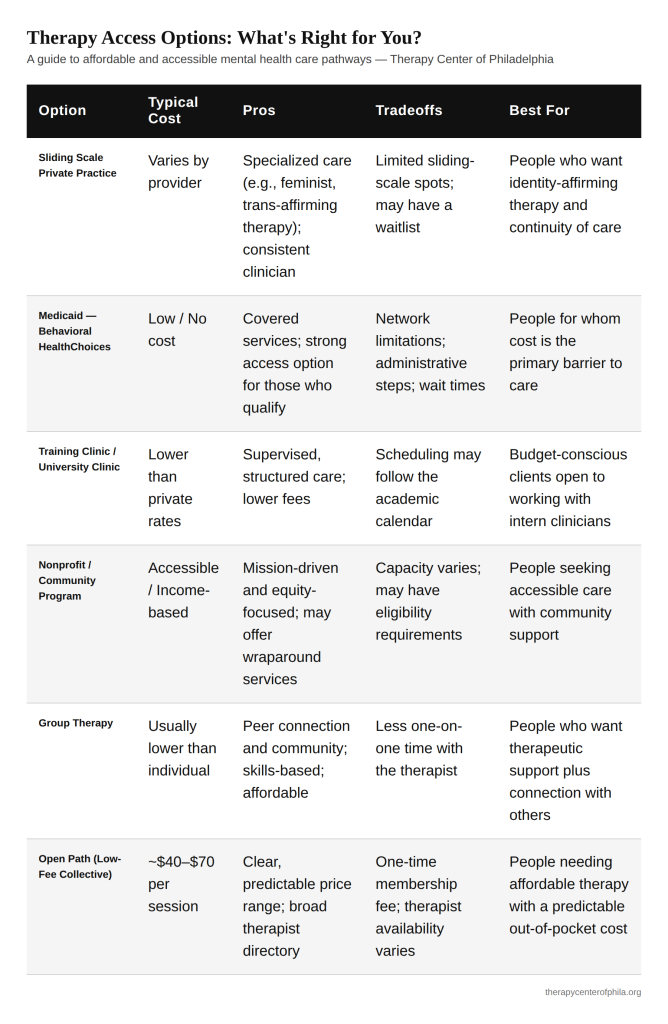
There isn’t one magic directory that solves everything. Most people find care faster by searching in layers, starting with the options most likely to be both affordable and affirming.
Here are the main routes.
1. Sliding Scale Private Practices (Including Identity-Affirming Specialties)
Many private practices set aside a portion of their caseload for low-cost mental health services. When this works, it can be a great match: consistent scheduling, specialized support (such as trauma, relationships, or identity exploration), and an environment designed for privacy.
This is often where you’ll find:
- Women’s therapy Philadelphia
- Feminist therapy / a feminist therapist
- Identity-affirming therapy
- BIPOC therapy and other culturally responsive approaches
- Clinicians explicitly offering Transgender mental health support
Tip
Don’t assume “sliding scale” is listed on the website. Some providers only discuss it when asked (because they’re trying to manage limited spots).
2. Medicaid And Pennsylvania’s Behavioral HealthChoices Program
If you have Medicaid (Medical Assistance in PA), you may have access to covered mental health services through the state’s managed behavioral health system. Pennsylvania’s Behavioral HealthChoices program connects Medicaid members to mental health and substance use services, typically coordinated through county offices and a behavioral health managed care organization.
This route can be a strong option for accessible mental health care, but it sometimes involves:
- Provider network limitations
- Waitlists
- More paperwork than private pay
Still, if cost is a major barrier, it’s one of the most important pathways to explore.
3. Training Clinics And University Counseling Centers
Philadelphia has multiple universities, and many areas have training clinics where advanced graduate interns provide therapy under licensed supervision. Fees are often lower than private practice, and many clinics are experienced with anxiety, depression, trauma recovery, and identity-related stress.
This can be a good fit if you want:
- Lower cost sessions
- A structured clinic setting
- Support that still follows evidence-based standards
4. Community Mental Health Centers And Nonprofit Counseling Programs
Some community programs offer low-cost mental health services through grants, donations, or public funding. Availability varies, but these programs can be particularly important for people navigating complex stressors like housing, discrimination, family conflict, or unemployment.
5. Group Therapy And Support Groups
Group therapy is often more affordable than individual therapy and can be especially powerful for:
- Building connection
- Reducing shame and isolation
- Practicing relationship skills in real time
If you’re looking for community-oriented support in intersectional mental health care, group formats can be a great complement (or starting point).
6. National Locators And Low-Cost Therapy Collectives
If you’re open to teletherapy or you’re searching statewide (across Pennsylvania), a few reputable tools can help widen your net:
- FindTreatment.gov (SAMHSA) is a confidential locator for mental health and substance use treatment services.
- Open Path Psychotherapy Collective offers therapy at a set sliding-scale rate (typically $40–$70 per session) with a one-time membership fee.
These can be helpful when local waitlists are long or when you need more options fast.

A Step-By-Step Plan To Find Sliding Scale Therapy In Philadelphia (Without Burning Out)
1. Decide Your “Non-Negotiables” And Your “Nice-To-Haves.”
Write down 3–5 must-haves. Examples:
Non-Negotiables
- LGBTQ friendly therapy
- Trans-affirming therapy/gender affirming counseling
- Trauma-informed therapy
- Evening appointments
Nice-To-Haves
- Center City Philadelphia therapy location
- West Philadelphia therapist
- South Philadelphia counseling
- BIPOC therapy focus or anti racist therapy lens
This keeps you from spiraling into 50 tabs and no decisions.
2. Set A Realistic Budget Range (Even If It’s Small)
Instead of “I need cheap therapy,” try:
- “I can do $40–$60/session right now,” or
- “I can do $20/session until my job situation changes.”
A sliding scale only works when people can name a number.
3. Search In Waves (5–8 Inquiries At A Time)
Send a short message to 5–8 providers or programs, then pause and wait for replies before sending 20 more.
Why
Therapy searches are emotional. “Batching” reduces the feeling of constant rejection or overwhelm.
4. Use A Script (So You Don’t Have To Reinvent The Wheel)
Here’s a simple message you can copy/paste:
Hi! I’m looking for sliding scale therapy in Philadelphia (or telehealth across PA). My budget is $__.
I’m specifically looking for LGBTQ friendly therapy/gender affirming counseling.
Do you currently have sliding scale openings or a waitlist? If a waitlist, what’s the estimated timeframe?
Thank you.
You’re not asking for permission to need affordable care. You’re asking a practical question.
5. Ask The Right Questions On The First Call
In a brief consultation, consider asking:
- “Do you have experience with Transgender mental health / working with gender expansive clients?”
- “How do you approach trauma-informed therapy?”
- “How do you make therapy culturally responsive?” (especially if you’re looking for culturally competent therapy or anti racist therapy)
- “How does your sliding scale work? Does it change over time?”
- “What’s your policy if I need to pause or reduce frequency due to finances?”
You deserve clarity up front.
What To Watch Out For (Without Getting Cynical)
A few signs a provider/program may not be the right fit:
- They avoid direct answers about cost or sliding scale
- They use pathologizing language about Queerness or gender diversity
- They treat “affirming care” like a marketing label rather than a practice
- They pressure you into fast decisions or don’t respect boundaries
At the same time, a slow response isn’t always a red flag. Many small practices are overwhelmed. That’s why having multiple leads matters.
Does Therapy Actually Help? (A Quick, Evidence-Based Reality Check)
It’s fair to ask, especially when money is tight.
Major health and professional organizations recognize psychotherapy as an effective treatment approach for many mental health concerns, including depression and anxiety. Research reviews also report that evidence-based psychotherapies are effective and cost-effective across a range of conditions.
That doesn’t mean every therapist is a perfect match or that progress is linear. But it does mean your effort to find care is grounded in something real, not wishful thinking.
If You Need Support Right Now (Crisis Resources)
If you or someone you care about is in immediate danger, call 911.
For urgent emotional support in the U.S.:
- 988 Suicide & Crisis Lifeline (call/text/chat)
- The Trevor Project (LGBTQ+ youth crisis support): call/text/chat options listed by Trevor
- Trans Lifeline (Trans-led peer support) U.S. (877) 565-8860 (call/text)

Bringing It Home: Affordable, Affirming Therapy Is Possible One Step At A Time
Finding sliding scale therapy in Philadelphia can take persistence, especially if you’re searching for gender affirming counseling, Queer-friendly therapy, or an explicitly Trans-affirming therapy space. But it’s not a dead end.
Start with a clear budget, use a short outreach script, search in small batches, and prioritize both affordability and fit. Whether you’re looking in Center City Philadelphia, working with a West Philadelphia therapist, or seeking South Philadelphia counseling, you deserve care that respects who you are and what you can realistically afford.
If you’d like to explore identity-centered, affirming therapy options, you can learn more about services through the Therapy Center of Philadelphia.