
If you’ve ever felt like therapy didn’t quite get you, or that it ignored the real-world systems impacting your mental health, you’re not alone. For women, transgender, and gender expansive people, therapy can sometimes feel like it happens in a vacuum: personal responsibility is emphasized while the larger forces of sexism, racism, homophobia, transphobia, and economic inequality are left out of the conversation.
That’s where feminist therapy comes in.
At Therapy Center of Philadelphia, we practice feminist therapy that is intersectional, trauma-informed, and identity-affirming. This blog will explain what feminist therapy really is (and isn’t), who it’s for, what you can expect from this kind of care, and how to access affordable therapy in Philadelphia, including sliding scale therapy, Medicaid, and low-cost mental health services.
What Is Feminist Therapy?
Feminist therapy isn’t a “therapy for women” or a place to talk about feminism in the abstract. Instead, it’s a way of doing therapy that:
- Centers the client’s lived experience, especially how identity and systemic oppression impact mental health
- Recognizes that power matters, both in society and in the therapy room
- Challenges traditional hierarchies, viewing therapist and client as collaborators
- Validates emotional responses to real injustices, not as overreactions, but as signs of survival
- Affirms identity, including gender, sexuality, race, class, disability, immigration status, and more
This approach integrates principles from psychology, social justice movements, and critical theory, but always starts from you and your needs.
Who Is Feminist Therapy For?
Feminist therapy is for anyone who:
- Has felt dismissed or misunderstood in traditional therapy
- Carries chronic stress or trauma connected to gender, race, or systemic harm
- Is exploring identity or navigating social transitions
- Feels the weight of burnout, especially in caregiving or activist roles
- Wants a therapist who “gets it” when it comes to power, privilege, and oppression
- Craves a space that affirms rather than pathologizes
While “women’s therapy” is a term you may encounter, it can imply a narrower focus than what feminist therapy actually offers. At Therapy Center of Philadelphia, we offer feminist therapy for women, transgender, nonbinary, and gender-expansive people across the full spectrum of identity.
What You Can Expect in Feminist Therapy
Here’s what feminist therapy looks like in practice, especially in our work across Center City, and through statewide teletherapy in Pennsylvania:
1. A Nonjudgmental, Collaborative Space
You’re the expert on your life. Feminist therapists support, witness, challenge, and walk with you, but never assume authority over your truth.
2. Focus on Systems, Not Just Symptoms
We explore how systems like patriarchy, white supremacy, and capitalism intersect with personal challenges like anxiety, grief, burnout, or low self-esteem.
3. Trauma-Informed, Consent-Based Work
Your pace is honored. We don’t push for disclosure or catharsis. Instead, we work in ways that prioritize emotional safety, nervous system regulation, and choice at every step.
4. Identity-Affirming Care
You won’t have to defend your gender, sexuality, culture, neurodivergence, or beliefs. Our team includes therapists who identify as queer, trans, BIPOC, and nonbinary, and who practice from a lens of culturally competent therapy.
5. Boundaries and Empowerment
Feminist therapy helps you understand how to reclaim your “no,” how to ask for what you need, and how to relate to others (and yourself) with more compassion and clarity.
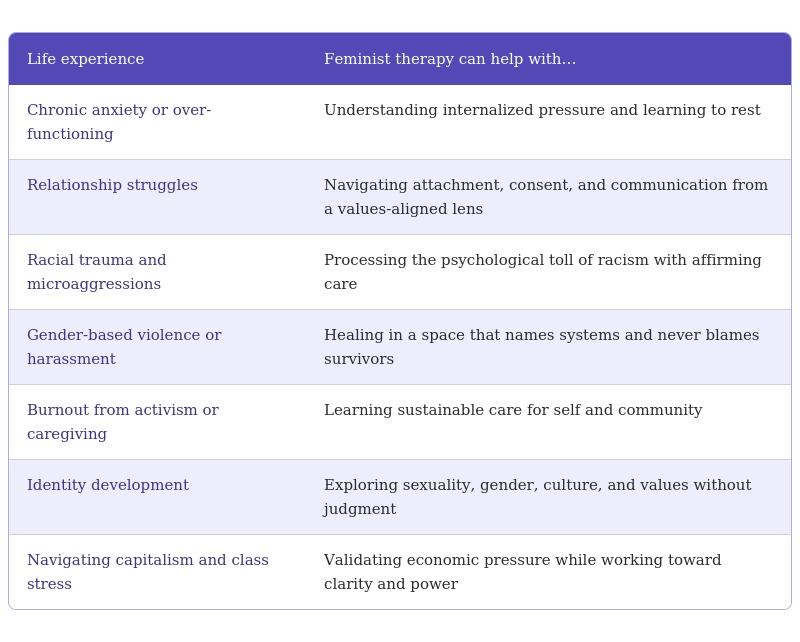
Common Reasons People Seek Feminist Therapy
You don’t need a specific “type” of problem to benefit from this approach. But here are some common entry points we see:
Feminist Therapy Is Also Anti-Racist and Intersectional
A truly feminist therapy space also means an anti-racist therapy space.
That means:
- Therapists reflect on their own positionality and power
- White therapists are responsible for doing anti-racism work, not relying on clients to teach them
- Therapy includes discussion of systemic racism, racial trauma, cultural loss, and colorism
- BIPOC-affirming therapy is not seen as a niche; it’s central to a liberatory model of care
Intersectional mental health care recognizes that experiences of gender are shaped by race, class, ability, sexual orientation, immigration status, body size, neurodivergence, and other factors. Feminist therapy doesn’t flatten that complexity; it honors it.
Why Philadelphia Needs More Feminist Therapy Options
Philadelphia is a city with incredible diversity and resilience, and also deep inequity. At Therapy Center of Philadelphia, we see clients who are:
- Advocating for reproductive justice, abolition, or mutual aid while burning out
- Experiencing medical gaslighting and health care discrimination
- Feeling stuck in cycles of trauma, shame, or survival mode
Traditional therapy models can sometimes pathologize those responses rather than contextualize them. Feminist therapy shifts the focus from “What’s wrong with me?” to “What happened, and what is still happening?”
That shift opens the door to healing rooted in reality, not perfection.
What Makes TCP’s Approach Different?
At Therapy Center of Philadelphia, we’ve built our practice around feminist values since 1972, when we opened as the Women’s Therapy Center. That’s not just a tagline, it’s more than 50 years of practice:
- We work only with women, transgender, and gender expansive people
- We prioritize access, offering sliding scale therapy, low-cost mental health services, and support for Medicaid clients
- We intentionally staff diverse clinicians, including nonbinary therapists, queer-identified clinicians, and therapists of color
- We train constantly on cultural competence, trauma-informed practice, and systems of oppression
- We’re community-rooted, not corporate-owned. Our care is shaped by the needs of our clients, not by insurance company quotas
Whether you’re looking for a feminist therapist in Center City, a therapist who gets your lived reality, or a counseling space that feels safe and affirming, we’re here to help you feel at home in yourself.
How to Access Feminist Therapy (Affordably)
Therapy shouldn’t only be available to people with top-tier insurance. We believe accessible mental health care is a right, not a luxury.
Here’s how clients typically access care with us:
1. Sliding Scale Therapy
We adjust session rates based on income and financial need. You won’t be shamed for asking. In fact, we encourage it.
2. Low-Cost Mental Health Services
We reserve a number of slots for clients with limited income. These are often filled, but waitlists are available.
3. Teletherapy
For clients across Pennsylvania, we offer remote therapy (when clinically appropriate), so you don’t need to travel to Philadelphia to receive support.
4. Insurance
We accept Aetna insurance and are actively expanding our insurance options, including Medicaid credentialing. If you have coverage questions, reach out and we’ll help you figure out what’s available to you.
You Deserve Therapy That Honors Your Whole Self
You shouldn’t have to leave your identity at the door to get mental health care. Whether you’re navigating trauma, burnout, relationships, grief, or self-discovery, feminist therapy provides a space that centers you, not just your symptoms.
At Therapy Center of Philadelphia, we’re committed to trans-affirming, queer-friendly, culturally competent, and anti-racist therapy that meets you where you are. If you’re seeking identity-affirming therapy in Philadelphia, we’re here to listen, witness, and support you as you grow on your own terms.
If you’re ready to connect, we’d love to hear from you. Call us at 215-567-1111, or visit www.therapycenterofphila.org or check out our blog at therapycenterofphila.org/blog to learn more.